Maximum quality
Uses less compression to preserve small text, stamps, handwriting, and image detail. Choose it when readability matters more than file size.
ScanLens is a PDF scanner app for iPhone that captures documents, detects page edges, creates multi-page PDFs, and runs OCR on-device in 14 languages. Scanning and document processing work offline; cloud backup and export are optional.

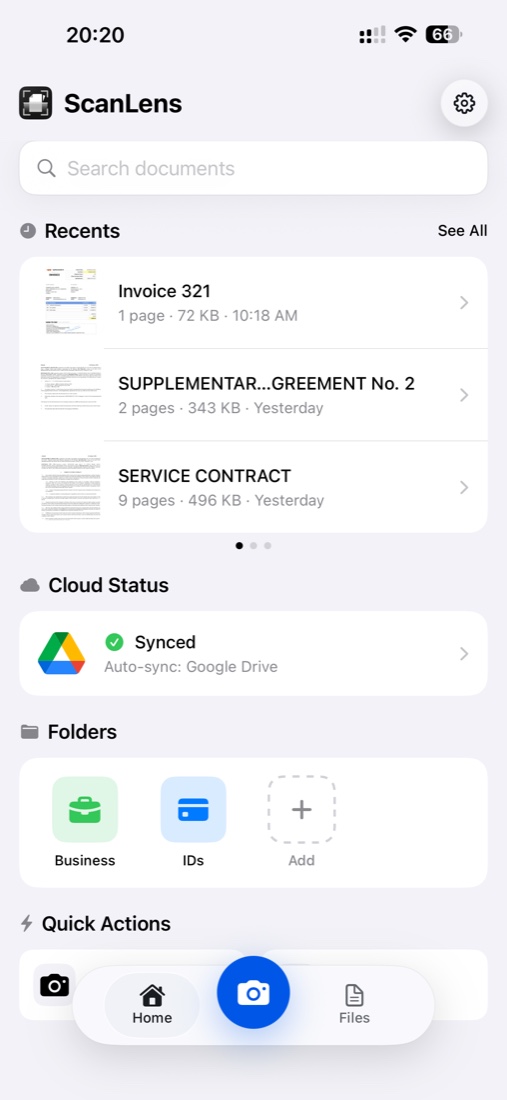
Open ScanLens, tap the + button, and choose Scan — capture is automatic once the page is in the frame. Repeat for the remaining pages, then save: the result is one multi-page PDF in your library, ready to share.
That is the whole scan-to-PDF workflow on iPhone. For paper that is already photographed, import the pictures instead — the same cleanup and PDF export apply — and for the capture technique itself, see using your phone as a scanner.
A camera saves separate images. A PDF scanner detects the page, corrects its perspective, combines multiple pages, and exports one document that is easier to search, send, and store.
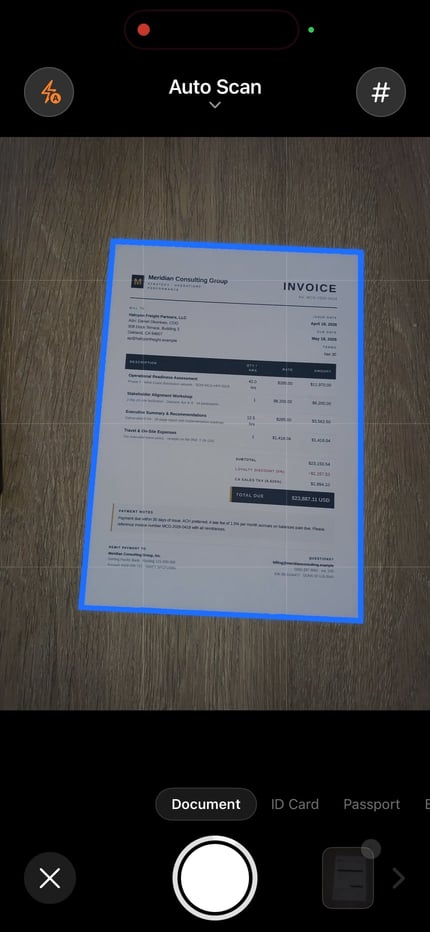
ScanLens detects the page edges and corrects perspective so the saved page is rectangular and easier to read.
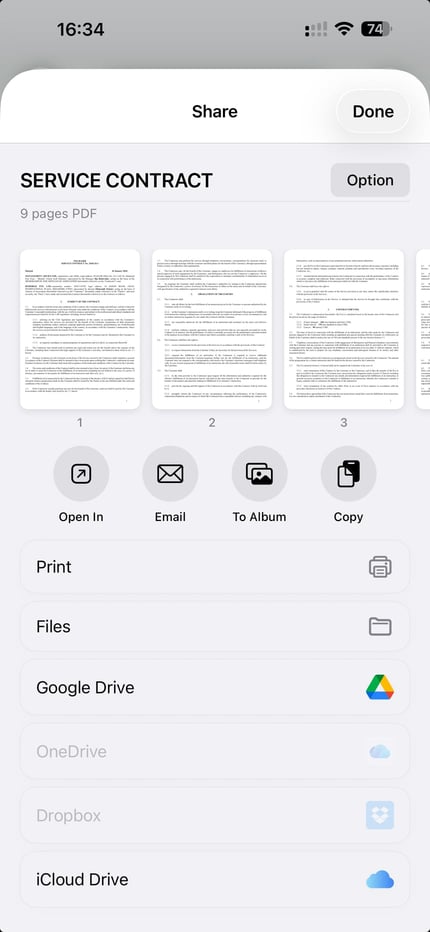
Capture every page of a contract or form, put the pages in the right order, and export them as one multi-page PDF.
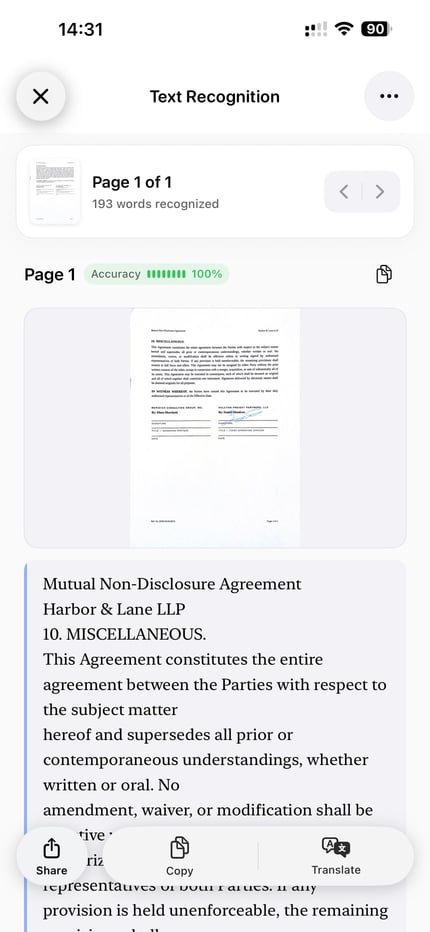
On-device OCR can add a text layer behind the page image, allowing compatible PDF readers to search and copy recognized text.
Choose more detail for print and small type, or stronger compression when an email or upload has a file-size limit. Preview the result before exporting.
Uses less compression to preserve small text, stamps, handwriting, and image detail. Choose it when readability matters more than file size.
Balances readable text and image detail against a smaller file size. It is the practical starting point for most documents.
Uses stronger compression when attachment size matters. Check small print and signatures before sending the result.
ScanLens can place recognized text behind the scanned page image. The PDF keeps the original visual layout while compatible readers can search, select, and copy the OCR text.
On-device OCR is available in 14 languages. Recognition quality depends on the language, page layout, lighting, focus, and source document, so review important names, dates, totals, and reference numbers against the original scan.
Learn more on our dedicated searchable PDF guide or the OCR app page if you need just the text extraction without the PDF wrapper.
Standard PDF is widely supported across phones, computers, mail clients, cloud drives, and document-management systems. The public ScanLens listing advertises standard PDF and searchable PDF export. Keep important records in storage you control, use clear file names, and maintain backups that match your retention needs.
Documents commonly saved as PDF include:
Add password protection before sharing a sensitive PDF. Send the password through a separate channel and retain an accessible original where appropriate.
Scanning, OCR, compression, and signing run on your iPhone. Document content is not uploaded to ScanLens for processing; optional backup and export use the services you choose.
ScanLens does not analyze the content of scanned documents. Account, purchase, analytics, diagnostic, and other app data practices are described in the App Store privacy label and Privacy Policy.
Export a PDF through the iOS share sheet or save a copy to Files, iCloud Drive, Google Drive, Dropbox, or OneDrive. Availability depends on the services configured on your iPhone and your ScanLens plan.
Scanning, compression, signing, and export stay in one document workflow, so the same PDF can move from capture to review and sharing without repeatedly importing it into different apps. The scan-and-email guide explains attachment size, Mail, Gmail, and Outlook workflows.
A PDF scanner app on iPhone detects the four corners of a document in the camera view, corrects perspective, combines several captured pages into one file, and can run on-device OCR to add searchable text behind the page image. ScanLens performs document capture, OCR, editing, compression, and PDF creation on the iPhone; document content is not uploaded to ScanLens for processing. Optional backup and export use the destination you select.
The iPhone already includes document scanning in Notes, Files, and Preview. Apple’s tools support automatic multi-page capture, page correction, filters, PDF output, text search in Notes, and signatures through Markup. For an occasional scan, they may be all you need.
A dedicated PDF scanner app becomes useful when the workflow needs searchable PDF export with an embedded text layer, compression controls, merge and split tools, password protection, reusable signatures, document organization, or dedicated modes for IDs and passports. The iPhone scanner comparison explains the differences without presenting built-in Apple features as ScanLens exclusives.
The workflow below covers capture, page correction, OCR, compression, and PDF export without promising a fixed time for every document.
| Step | Action | Tips |
|---|---|---|
| 1 | Open ScanLens and tap the camera | Lay the page on a contrasting surface — dark table, light page, or vice versa — for cleaner edge detection |
| 2 | Hold steady until the auto-capture fires | Or tap the shutter for manual. Batch mode keeps the camera open between pages — useful for contracts |
| 3 | Confirm the detected edges | Drag the four corners if the auto-detect missed; ScanLens straightens the perspective once you confirm |
| 4 | Pick a color profile and reorder pages | Black-and-white for receipts, color for IDs and photos, grayscale for contracts. Drag thumbnails to reorder |
| 5 | Choose compression and OCR language | Start with Balanced, choose Maximum when fine detail matters, and select the OCR language that matches the document |
| 6 | Export as PDF and share | Choose standard or searchable PDF, add password protection if appropriate, then use the iOS share sheet for delivery |
Signed agreements, NDAs, vendor invoices, purchase orders, and meeting handouts often arrive on paper but need to live in a project folder. Batch mode captures the pages in one session, OCR makes the text searchable, and compression can reduce the attachment size. For workflows that move between desk and field, the business document scanner guide covers naming conventions and folder structures.
Receipts curl, fade, and disappear from wallets. Scan them when you receive them, file the PDFs in a clearly named folder, and use OCR to make dates, totals, and merchants easier to find. Before relying on recognized values, compare them with the receipt. For pages that need to be combined or reordered before submission, see the PDF editing guide.
Tax forms, bank statements, mortgage documents, and expense records are easier to manage when each file has a consistent name and storage location. The public listing advertises standard and searchable PDF export, not a specialized archival format. Follow the retention rules that apply to you, keep backups, and use the searchable PDF workflow when you need to find a transaction or reference number later.
Passport pages, driver’s licenses, insurance cards, vaccination certificates, and booking confirmations contain sensitive information. Store only the copies you need, protect them appropriately, and verify whether a digital copy is accepted for the intended purpose. ScanLens processes document content on the iPhone; any backup or shared copy is handled by the destination you choose.
ScanLens exports standard PDF and searchable PDF with an embedded OCR text layer. The public App Store listing does not advertise a separate archival export format.
Yes. On-device OCR adds an invisible text layer behind every page image, so the PDF stays visually identical to the scan while becoming fully searchable in any reader.
Choose Maximum, Balanced, or Minimum compression, or use the custom control. Always check fine print, signatures, stamps, and image-heavy pages after stronger compression.
Yes. Add password protection before export, keep an accessible original where appropriate, and share the password through a different channel.
ScanLens supports multi-page documents with batch capture and page reordering. There is no fixed public page limit in the App Store listing; practical performance depends on the iPhone, page images, and available storage.
Core capture, edge detection, OCR, editing, compression, and PDF export work on the iPhone without a ScanLens account. Cloud backup, third-party cloud export, purchases, analytics, and diagnostics use the relevant network services as disclosed.
The current public listing states 14 OCR languages. Accuracy varies with the selected language, source document, layout, focus, and lighting, so check important recognized text against the scan.
Yes, within the scope of a flat-PDF tool. Reorder pages, delete pages, rotate, add new pages from a fresh scan, drop a signature, annotate, and re-export. For deeper edits — typing into form fields, redacting sensitive lines — see the PDF editing and PDF signing workflows.
ScanLens is one, with the boundaries stated plainly. Scanning and importing are unlimited, no account and no email address are required, and edge detection, perspective correction, page filters, crop and rotate all work without unlocking anything — the output is a real multi-page PDF. Free exports carry a ScanLens mark, and the pricing page lists what the paid feature set adds. There is no separate desktop download: it is one iPhone app.
Capture documents, create multi-page and searchable PDFs, compress files, add signatures, and export from your iPhone.